

A few months ago, someone left a comment on an article I wrote suggesting that there are “things I don’t understand about menswear,” because I’m not an insider.
I don’t think their comment was malicious, but I do think they were right.
I am not a “fashion industry insider.”
I’ve never worked in this industry before, but I really love clothing. The last 15 years of my life have been consumed by learning as much as I can from wherever I can, and that obsession has enabled me to share some of what I know.
This is my first post for Sprezza, and on a recent call with the team, we were yapping about the equilibrium between product value and price point.
Leon (fellow Sprezza writer) asked me: “Do you think customers actually care about all these details?”
I went on a rant, and was promptly encouraged to share my thoughts publicly.
So, here it goes.
Welcome to the metaphorical menswear pool
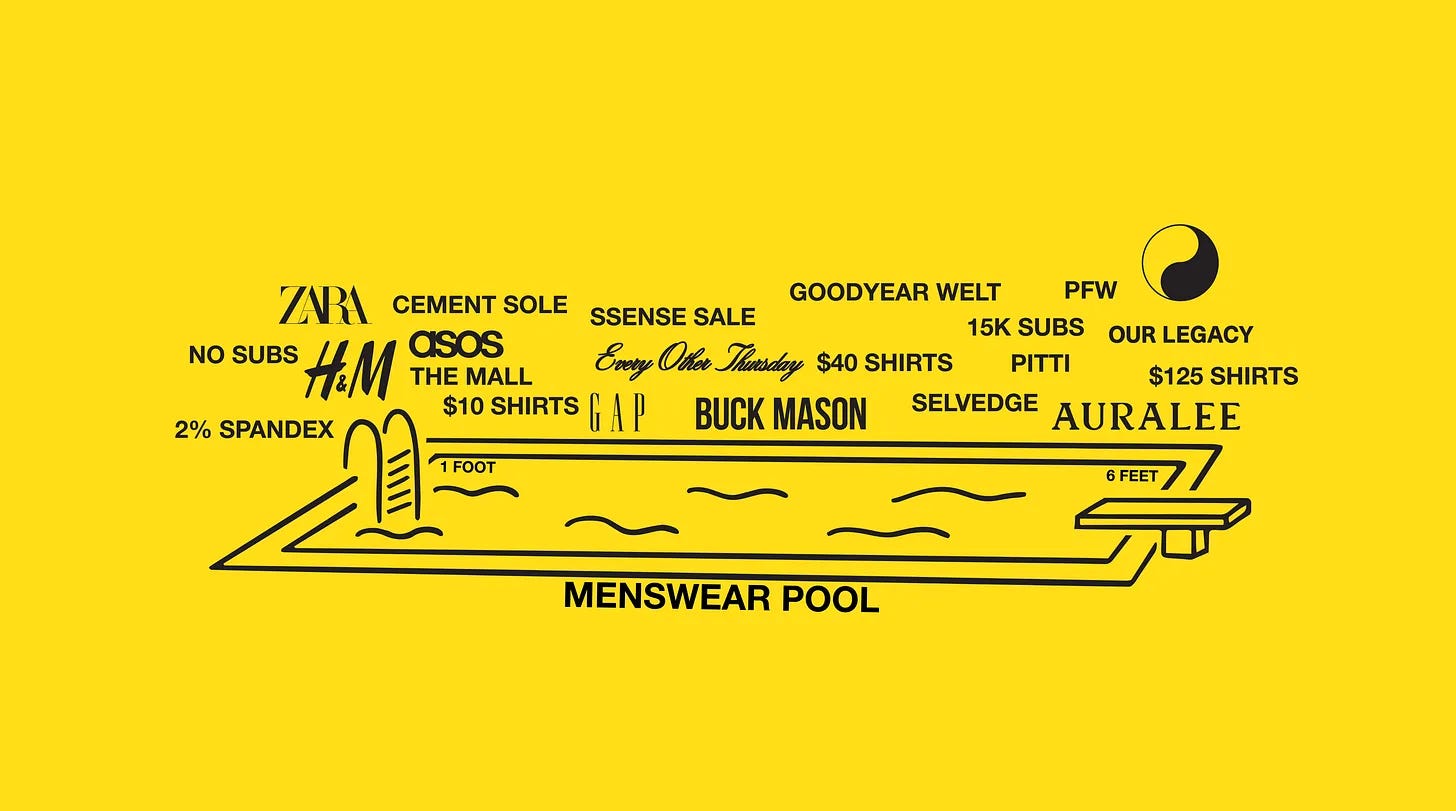
If menswear were a metaphorical pool, I’m 4 feet deep in a 6-foot pool. I see the insiders jumping off the diving board into the deep end, and I also see the newcomers putting on their floaties as they prepare to get out of the splash deck. I tread awkwardly in the middle, passing info along to both sides.
And from here, I recognize that both sides can learn from each other.
The insiders (on the deep end): I agree with you on all things costs, quality, and production. The reality is, the guys who are just stepping into this world think very differently from us and are looking for things in very specific categories.
In most cases, the fit & cost of something will sway the buyer. Manufacturing, materials, and technical details are secondary.
I had to pressure-test this, so I texted three of my [non-insider] friends to ask what they consider when buying clothing.
Their responses were:
Manufacturing practices…I want to see if a company takes pride in its work
Material, fit, and cost (in that order)
I don’t think about materials. Fit + cost are my first thoughts.
I’ve managed to spend enough time with the first two guys to have dragged them a little deeper into the pool. But the third answer reflects the majority of people who are on the outside looking in: they want to know how it fits and what it costs.
Everybody.World really nails this with their trash t-shirt collection. Their info is simple, their t-shirt fits are easily named (trash tee, boxier trash tee, tailored trash tee), and they start at $40, which is more than what you’d pay at the mall, but also cheaper than what you’d spend at a specialized brand.
Is it better than what you’d get from Dehen 1920 or Merz B. Schwanen? No, but I don’t think they’re trying to compete.
Elwood is another one. I hate everything they do am not their target customer, but multiple guys I’ve spoken to have said they’ve bought their stuff because of their product breakdown videos, all 45 seconds long.
Cost matters too. At a time when people are struggling to pay bills, buy groceries, and cover their mortgages, it’s hard to consider spending +$65 on a really great tee when a pretty good one costs $40.
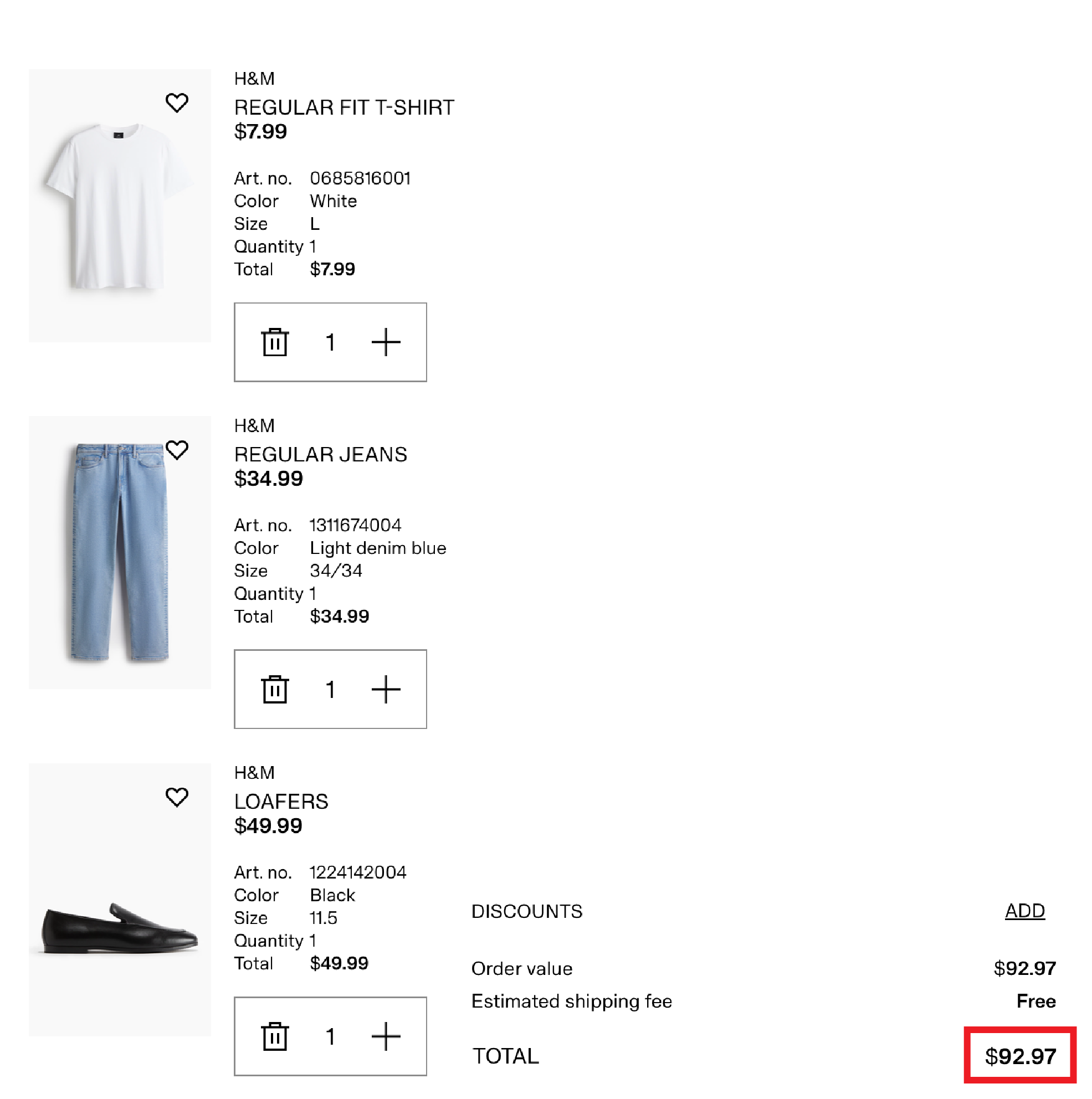
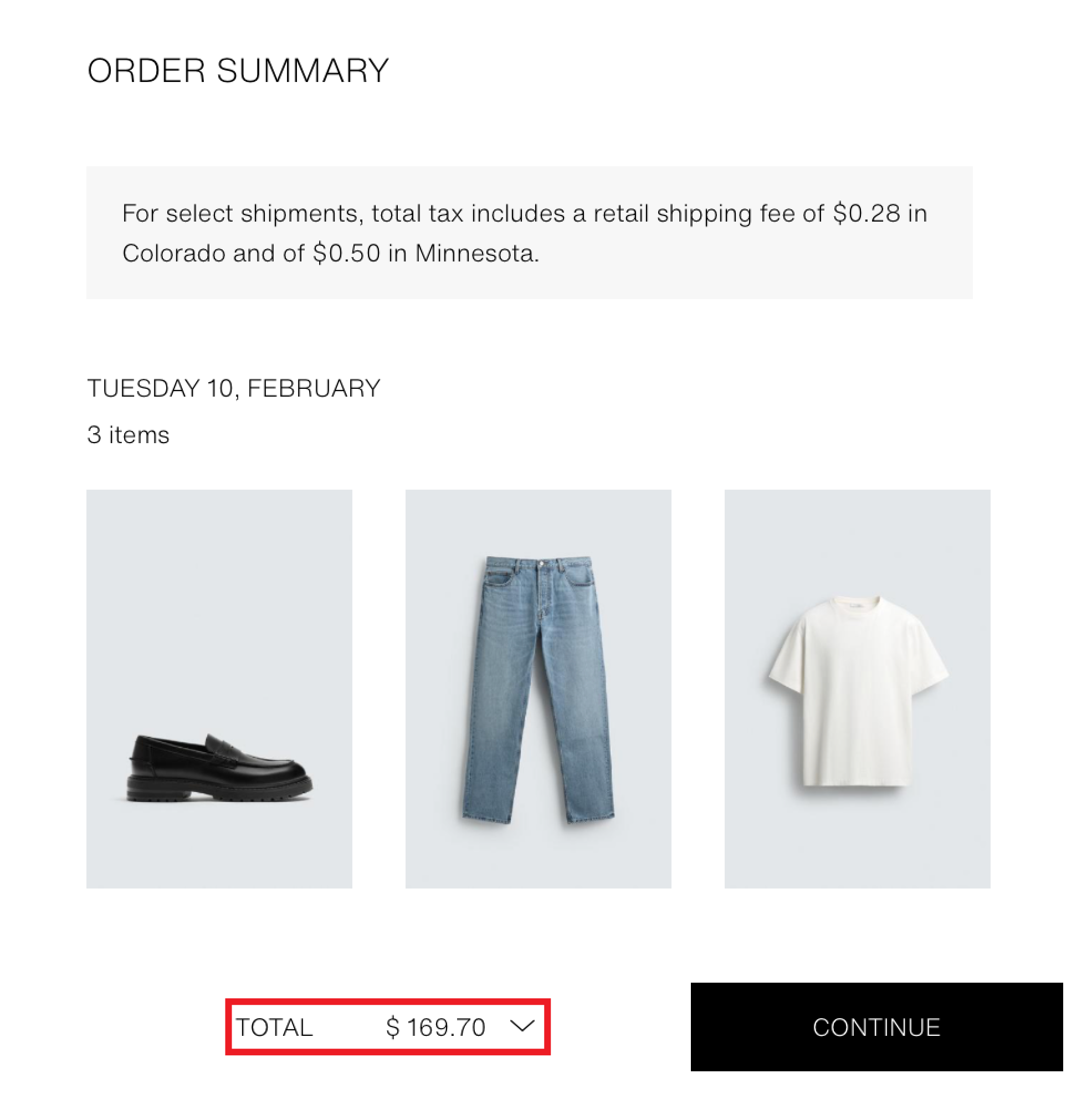
Consider the total. cost in purchasing three of the same products from from three different brands.
First, we have H&M.
Then, Zara.
Finally, Buck Mason.
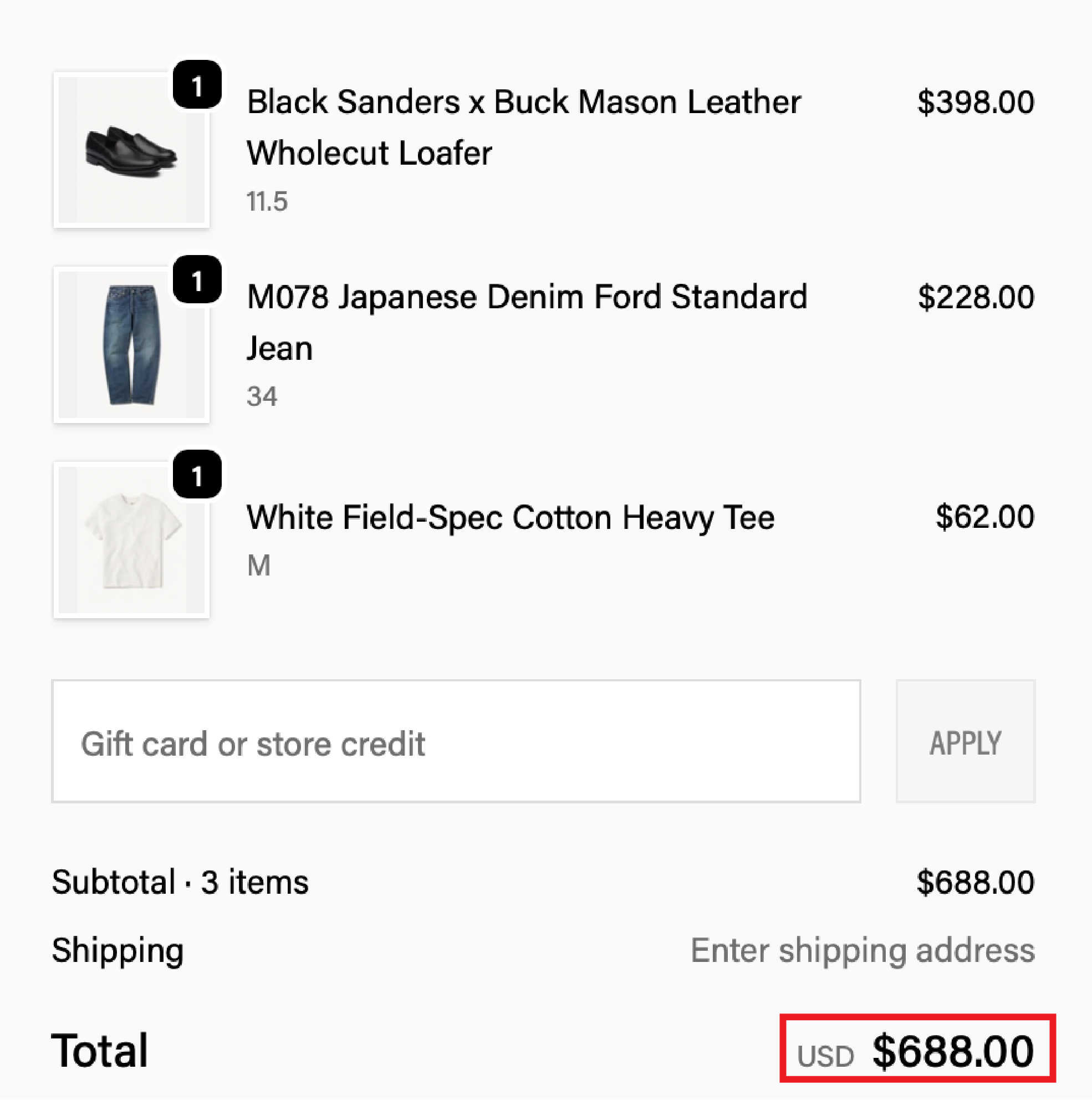
Same items at checkout.
Tee, jeans, loafers.
At H&M, $93.
$170 if you cop at Zara.
And at Buck Mason? $688 big ones.
Which one seems most appealing to the guy who doesn’t “know any better?”
I’m not saying that the finer details don’t matter. But you will not catch the guy who wants to look good at an affordable price, geeking out on the details. Yes, they should be educating themselves (more on that later), but until they get there, they’ll be shopping differently.
(1) Will this fit me well? and (2) What will it cost me to have something that fits well? Whoever manages to answer that in the simplest terms will win over that portion of the market.
The market for quality basics is huge and extremely popular, even if it’s oversaturated.
Back to our call. Leon also made the point that Buck Mason is the benchmark for what people consider good quality right now. It’s elevated enough for the mall shopper to feel they’re stepping up in quality, yet it’s also crafted and styled in a way that someone who shops at RRL will find something they like.
Their pricing seems to be the average someone would be willing to pay for a good product. Let’s use a pair of their Japanese Denim Ford standard jeans that cost $228.
That price is the absolute most I can expect someone (who is interested in buying their first good pair of jeans) to spend. And yet for those who nerd out on this stuff, $228 is where the really good stuff begins.
It’s also why I believe brands like Every Other Thursday ($194 for jeans) and Hanover ($155) have the opportunity to print money.
Because if Buck Mason’s jeans are too expensive, there are a ton of really good options that appeal to someone who wants to both look good and save money.
“We don’t need another social media influencer brand.”
Hey, I don’t disagree. But the quality is good, and the price point is appealing to consumers. I’m not saying I even necessarily like these brands but I can’t argue that they’re doing the right thing at the right time, offering exactly what people are asking for.
Two examples of this are Colbo x Zara and Aaron Levine x Zara, which have a [thin] silver lining.
For the love of God, do not start an argument with me here. I personally feel these are bad for many reasons, BUT.
Look at these texts I got, two weeks apart.
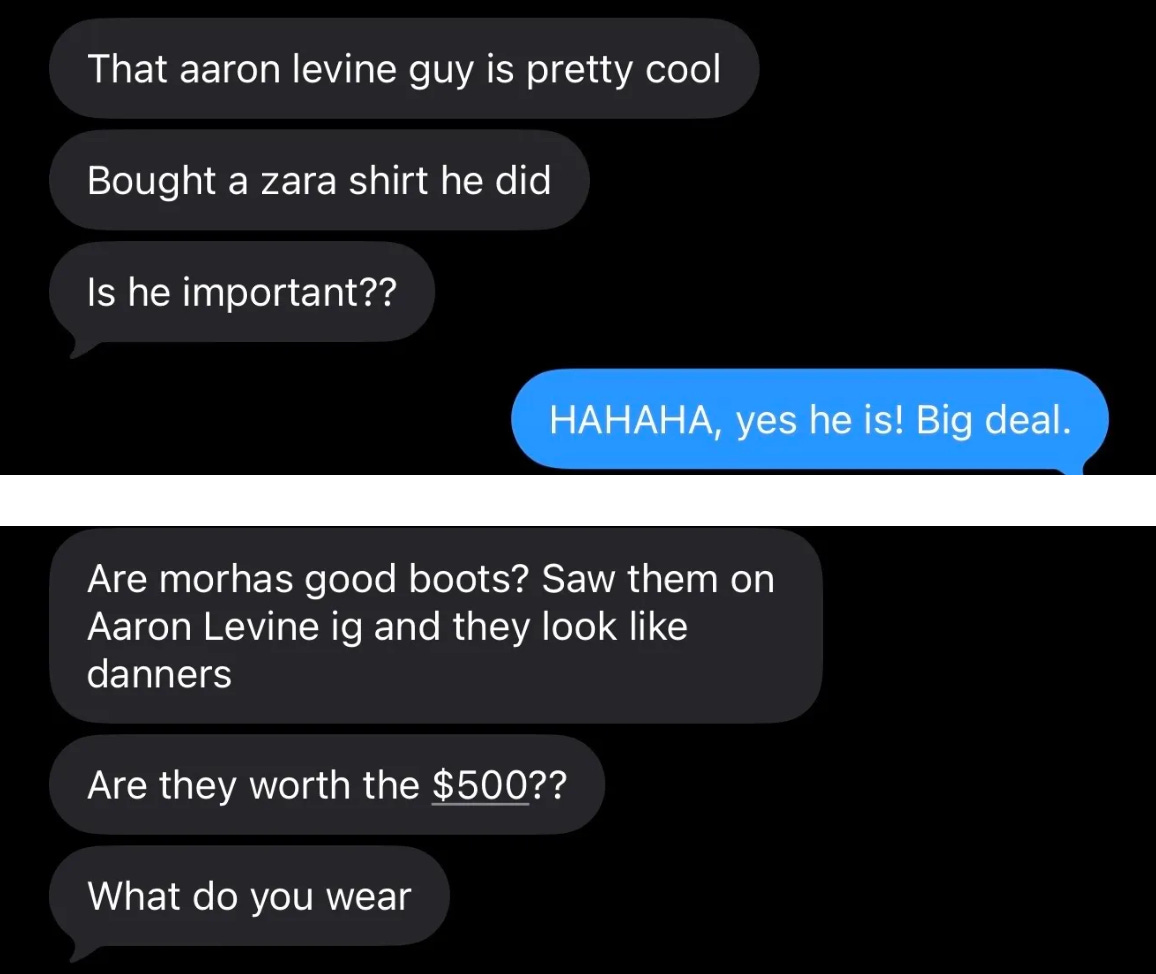
At one point, we were all new to this. A collab like this introduces someone who is slightly interested in menswear to Aaron Levine as a reference point, and it opens the door to a whole new world of brands.
For me, that was Four Pins (RIP).
When I discovered that blog, I followed all the writers on Instagram and every brand they talked about. It led me out of the mall brand wasteland and into the loving arms of the SSENSE sale section.
We all need that moment where a brand or a person unlocks the rest of the industry for us, and I think (or at least hope) that’s what is happening here.
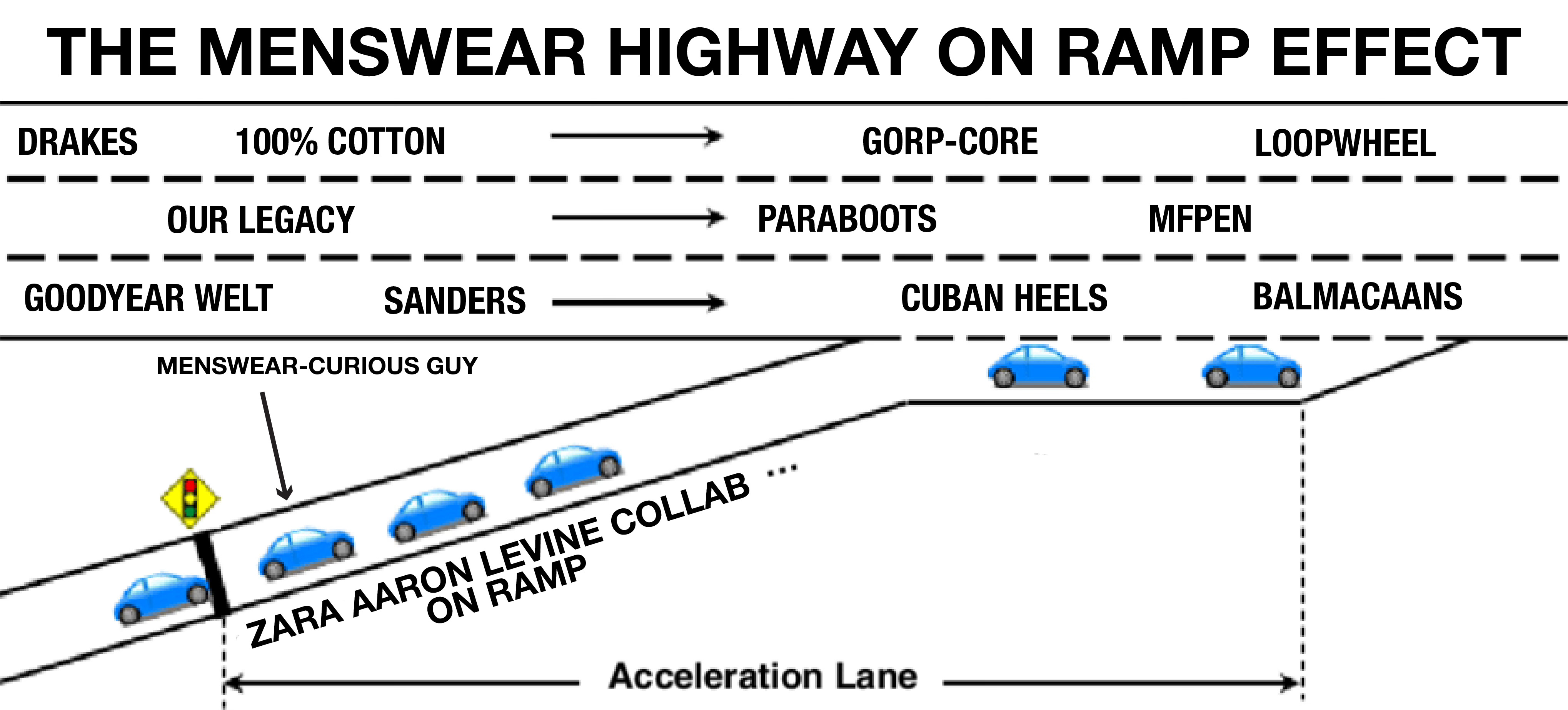
We all gotta start somewhere, even if Zara is the gateway.
SHALLOW END NEWCOMERS:
You guys are screwed. Genuinely. You wandered into a whirlpool that pulls you in and spits you out broken. You’ll spend more money than you want, order the wrong size a ton, and you will be haunted by the regret of missed purchases.
Here are some things you need to know to save you a lot of time and energy.
How you shop matters, and paying full price is worth it.
I just went to bat for you a few paragraphs ago about how times are tough, and costs play a huge part in how you shop, so now I need you to meet me in the middle.
A few years ago I was in the market for a pair of wallaby-esque shoes, and I ended up going with the 3Sixteen + Padmore & Barnes P404 rather than a pair of Clarks.
The price was $100 more but I felt like it was worth it. And sure enough, upon posting and tagging Andrew, he replied with this:
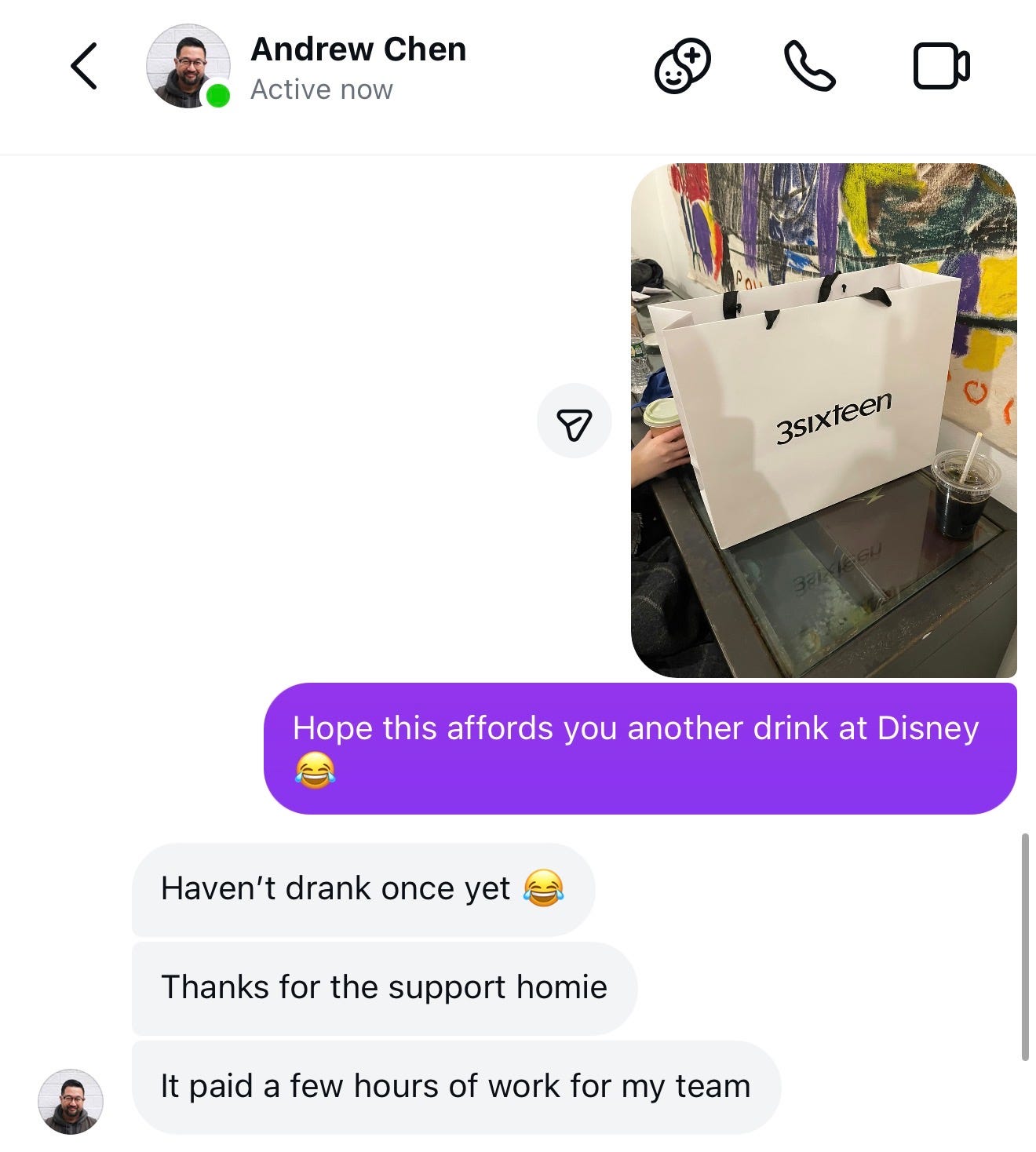
I’m glad Andrew kindly corrected my comment: That purchase helped pay his staff and keeps the whole business healthy. When you put money into a good store or brand, you’re helping make sure everyone’s able to pay their bills and live their lives.
Online shopping removes the human experience from the equation.
Stepping into a physical store, that changes. When I got fitted at Drakes and was asked what size I wear, which pieces of clothing I usually wear, and how I like my coats to fit, they weren’t just making a sale; they were making sure the pieces I bought would fit my lifestyle and work with my wardrobe.
You don’t get that human experience online.
You’ve got bills and want to afford a good t-shirt, but the person helping you at the store also has bills and wants to afford one. You’ll pay more, but you'll see where that money goes and how it helps keep someone else fed.
When you can afford to do it, paying for quality clothing is the best financial and ethical decision you can make.
I bought a pair of Trickers boots in 2015 for about $400 that are only now needing to be resoled…after a DECADE of wear.
My cost per wear is $40/year.
You could go to any mall brand, find the cheapest black boots ($60 from H&M), replace them every time they break, and over 10 years, I’d still have made the better financial decision.
And now, for ~$100, I can get mine resoled for another decade of wear.
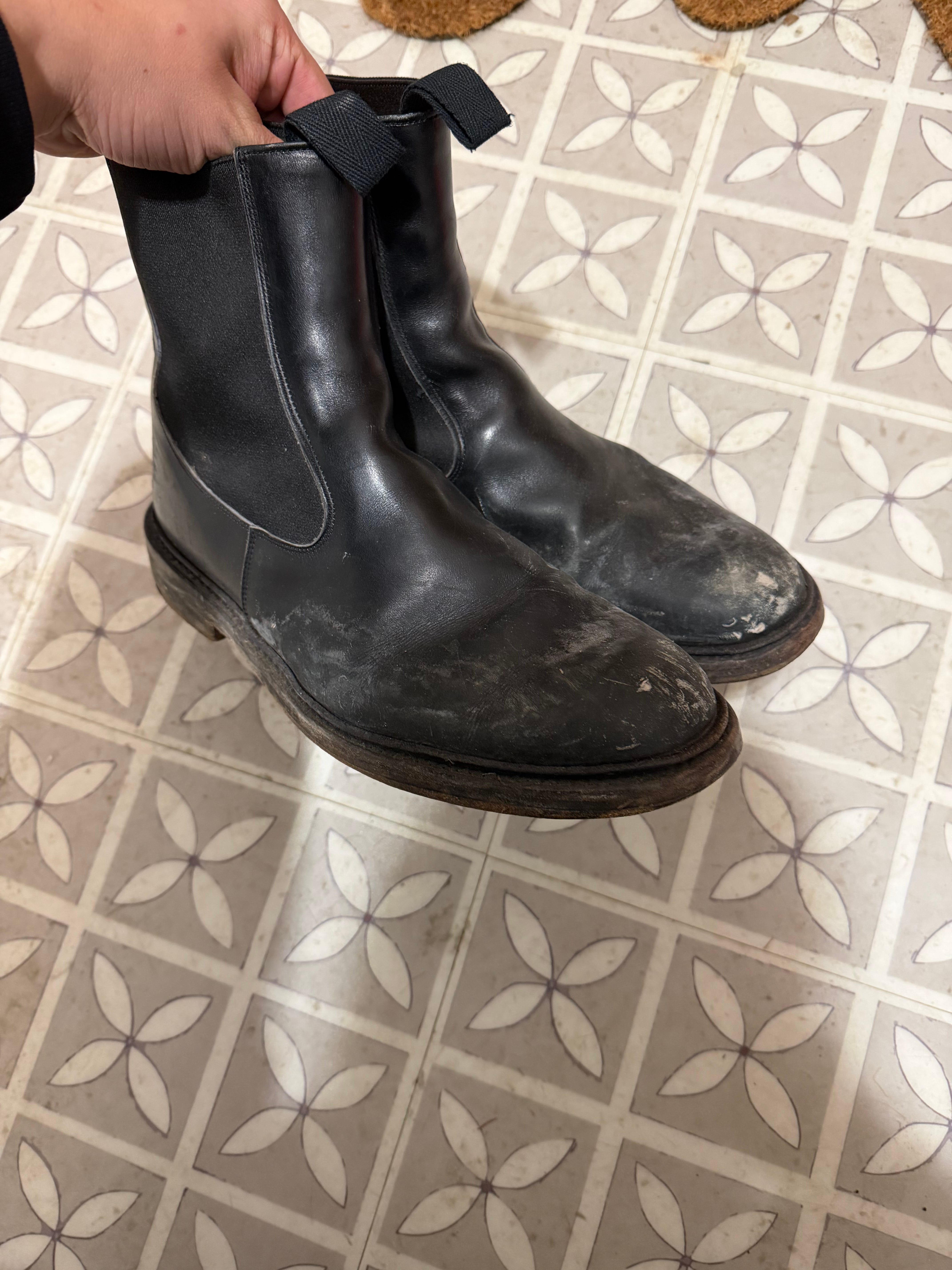
Weddings, concerts, long days in the city, slow days in the office...they’ve seen better days since 2014. Coming soon: Vibram Commando sole.
The boots theory checks out. It’s also the most ethical choice. 10 pairs of H&M boots over the course of a decade (for comparison) create 10X the waste, 10X the exploited labor, and feed the idea that consumerism will fix the gaping hole of sadness in your life.
But it won’t.
I know how daunting it is to spend $400 on a pair of boots. But I think that is also due to a shift in how we value clothing today. Look at this fact from the Bureau of Labor Statistics:
In 1901, the average U.S. household allocated 14.0 percent of total spending for apparel…By 2002-03, spending shares for clothing had decreased to 4.2 percent in the country as a whole.I cannot unpack all the reasons why I think we’ve decreased the amount we spend on clothing today, so I’ll summarize: Offshoring labor for clothing production, along with poor labor standards across those countries, has led us to believe that clothing can always cost less without having to wonder why that’s the case.
Articles of Interest did a great episode on how, even in America, the labor costs are worryingly low. Even if a pair of boots can cost $60, it’s in your best interest to avoid putting money into a system that only serves to exploit and punish minorities, women, and children.
This is the easiest time to learn anything you need to know about clothing and products.
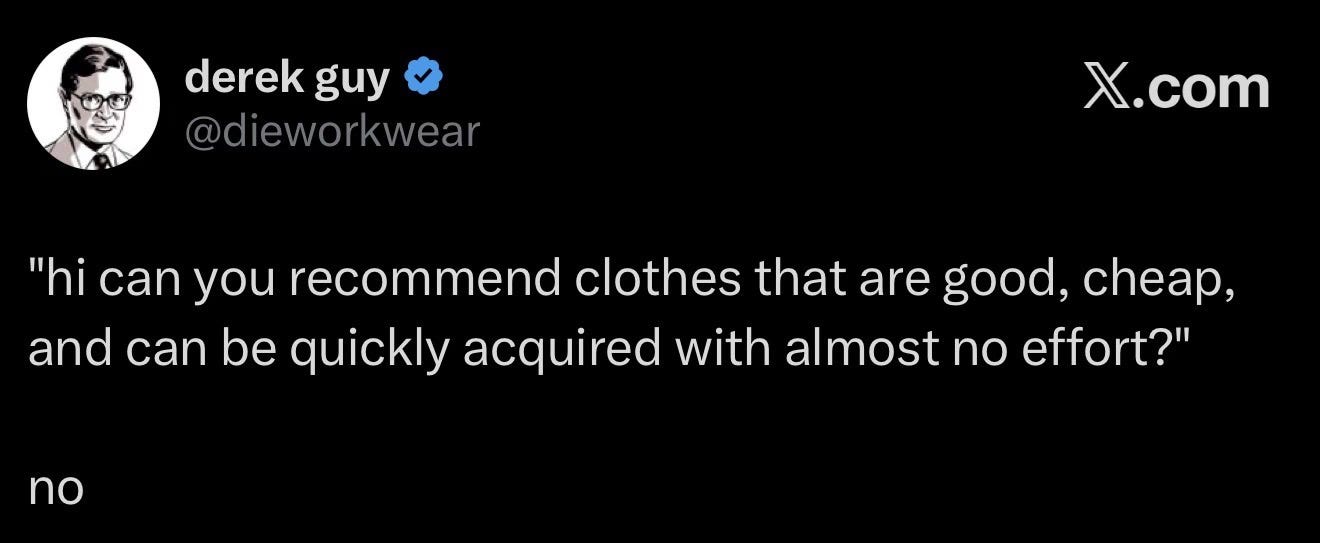
A decade ago, I had to dig through forums for basic info, and a decade before that, it was even more difficult. Today we have so many blogs, podcasts, websites, and menswear reels to bring you up to speed on anything you’re looking for.
It is almost more difficult to stay uninformed than it is to learn about what’s out there.
And I get it, the general consensus is that menswear guys in the scene can be intimidating. I used to think that too. But let me let you in on a little secret…
Bro…the guy you’re intimidated to ask a question to is a nerd that’s currently in a forum arguing about how often you should wash your denim. He hasn’t spoken to a girl face-to-face in years.
Everyone in this space is a nerd at their core, someone who found freedom in spending too much money on a pair of jeans.
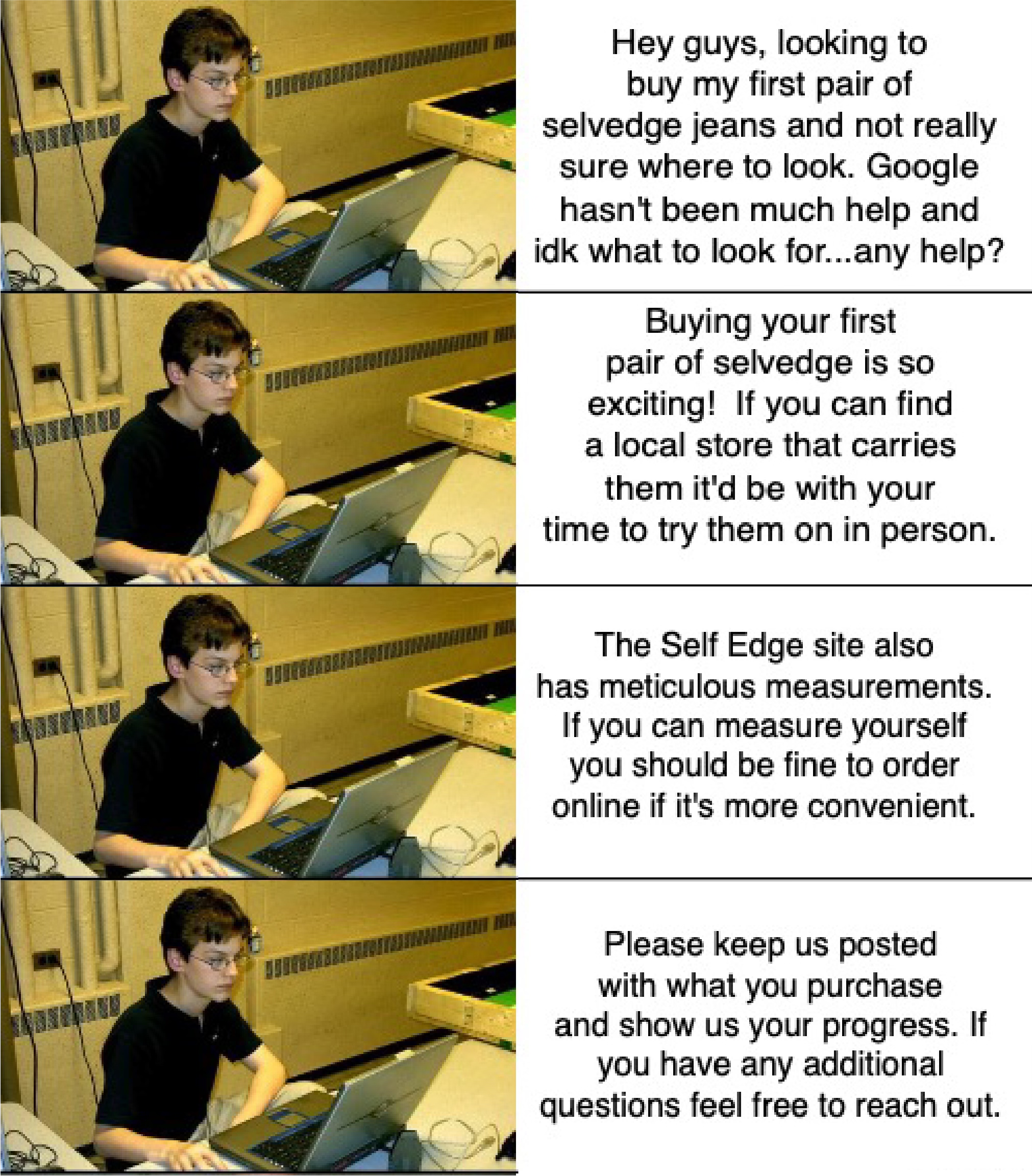
Put yourself out there online, show up to events, visit shops, ask questions, and you’ll quickly see that it’s not nearly as scary as it all seems.
The good people want you to find your spot in the scene and will be helpful in educating you along the way.
Not to get all sappy, but menswear has made my life better in more ways than I can count, and I’m stoked to be able to peek behind the curtain to see how the machine works.
I also love my friends who have no idea how to pronounce Loewe.
It’s easy to make this into an insider/outsider debate, but that feels disingenuous. Whether you’re a veteran shop owner or an accountant who just bought his first pair of good jeans, you’re likely reading this because you care about clothes on some level.
The tension isn’t disagreement; it’s language. Two groups who care about the same thing but don’t always know how to talk to each other. I’ve seen what happens when someone who walks out, saying “That shirt was too expensive,” gets the chance to actually understand what goes into making it.
Sometimes they still don’t buy it, sometimes they come back.
Either way, the conversation changes.
What’s helped me is staying in the conversation: reading more, asking questions, leaving comments, walking into shops, and talking to people who know more than I do. The more I engage, the less intimidating the whole thing becomes, and now I’m able to pass along what I know to the next person.
We’re all in the same pool.
Some are wading in the shallow end, others diving into the deep end. The pool is not as long as it seems, and we’re closer than we think.

love the point about supporting small business — yes you’re paying a lot of money for a jawn, but you’re also supporting a small business and that wins 100% of the time for me.
Well put. The pool metaphor is relatable and the fit + price-first mindset feels accurate. Most people just want to look good without overthinking it, and that’s totally fine...I also like how you treat Zara/mall brands as gateways instead of punching bags, everyone's gotta start somewhere, but hopefully that gateway leads them to more thoughtful consumer choices...